For some people, treatment abroad goes smoothly. But full mouth dental implant treatment is a significant, long-term commitment, and where it’s carried out affects far more than the upfront price. Aftercare, continuity of care and how complications are managed all matter just as much as the treatment itself.
This article looks honestly at the considerations involved in travelling abroad for implants, so you can weigh up all the factors rather than the headline cost alone.
Why are dental implants in Turkey so popular?
The main draw is cost. Advertised prices for implant treatment in Turkey can look considerably lower than in the UK, and clinics often present this alongside shorter waiting times and all-inclusive packages covering accommodation and travel.
For patients who’ve lived with failing or missing teeth for a long time, the idea of resolving everything quickly and affordably is understandably appealing.
It’s worth understanding what sits behind those lower prices, and what the advertised figure may not include. Lower operating and labour costs in Turkey account for some of the difference. But the way treatment is planned, delivered and supported afterwards can also differ from what you’d expect in the UK, and those differences are where the real considerations lie.
Understanding the true cost of treatment abroad
The advertised price is rarely the full picture. When weighing up treatment abroad, it helps to consider the total cost over time, not just the initial quote.
Factors that can add to the real cost include:
- Flights and accommodation, sometimes for more than one trip
- Time off work for treatment and any follow-up visits
- Return travel if adjustments or repairs are needed
- Corrective treatment in the UK if something goes wrong
When these are added together, the gap between treatment abroad and treatment at home can narrow significantly, particularly if follow-up care or repair work is needed later.
The risks worth understanding
Limited access to long-term aftercare
Full mouth dental implants aren’t a one-off event. They need ongoing reviews and maintenance to stay healthy and functional over the years, and problems are far easier to manage when they’re caught early.
When treatment is carried out abroad, arranging that ongoing care can be difficult. Routine maintenance, adjustments and check-ups all become harder to access once you’re back in the UK, and the clinical team who planned and placed your implants is no longer close at hand.
Complications can be harder to resolve
As with any treatment, complications can occasionally occur, such as infection, issues with how the teeth fit together, or problems with the new teeth themselves. These situations are usually manageable, but they rely on prompt access to the team who understands your case.
If that team is in another country, resolving a problem can mean further travel, delays and added cost, at a point when you simply want the issue dealt with quickly and locally.
Treatment may be rushed into a short timeframe
Full mouth implant treatment involves careful diagnostics, detailed planning and, in many cases, staged healing. This considered approach is part of what supports a predictable, long-term outcome.
When treatment is arranged around a short trip abroad, there can be pressure to complete complex work within a limited window. Thorough planning and appropriate healing time are difficult to rush, and rushing them can affect the result.
Clinical and regulatory standards may differ
Dental care overseas is regulated differently to the UK. This isn’t about the quality of any individual clinic, many provide good treatment, but about your ability to understand the standards that apply, know what protections you have and know where to turn if you have concerns.
In the UK, dental care is regulated by the General Dental Council, and patients have clear routes for raising issues. It’s worth understanding what equivalent protections apply before committing to treatment in another country.
Corrective treatment can cost more than expected
If treatment abroad doesn’t go to plan, putting it right can be more involved and more expensive than the original work. Corrective full mouth implant treatment is complex, and beyond the financial cost, there’s often a real emotional toll for patients who feel they’re back at the start after hoping the matter was resolved.
Why continuity of care matters
One of the biggest differences between treatment abroad and treatment at home is continuity of care, having the same clinical team involved from your first assessment through to your aftercare.
Continuity means the people looking after you understand your history, your treatment plan and your individual needs at every stage. If a question or concern comes up months or years down the line, you’re dealing with a team who already knows your case, rather than starting again from scratch.
For treatment as significant as full mouth dental implants, that ongoing relationship is a meaningful part of a predictable, long-term outcome.
How UK-based full mouth implant treatment compares
At EvoDental, full mouth dental implants are all we do. For more than 18 years, we’ve helped thousands of patients across the UK move beyond the limitations of failing teeth and dentures, with treatment planned and delivered by an experienced clinical team.
Much of what draws patients abroad, a fixed smile completed quickly, is available here too, but with your care kept close by. The table below shows how treatment at a UK clinic like EvoDental compares with a typical overseas package.
| What matters | A UK clinic like EvoDental | A typical clinic abroad |
| Assessment and planning | Detailed assessment with CT scan and 3D imaging, planned around you | May be shortened or rushed to fit a short trip |
| The clinical team | The same team from assessment to aftercare | Often a team you meet only once, in another country |
| Treatment time | Fixed teeth in a single day, with realistic healing time | Complex work compressed into a holiday window |
| Sedation | IV sedation included at no extra cost | Varies, and not always available |
| Aftercare and reviews | Straightforward to access, close to home | Requires return travel to arrange |
| If something needs fixing | An experienced team nearby who knows your case | Further travel, delays and added cost |
| Regulation and protections | Regulated by the GDC, with clear routes to raise concerns | Different standards you may be less familiar with |
Choosing UK-based treatment means:
- Your assessment, planning, treatment and aftercare are handled by the same team
- Ongoing reviews and maintenance are straightforward to access
- If a concern arises, support is close by rather than overseas
- Treatment is planned around your individual needs, not a fixed travel window
Our expertise in advanced implant placement also allows us to treat a wide range of cases, including complex ones. In many cases, this means there’s no need for bone grafts or sinus lifts, something that isn’t always offered elsewhere.
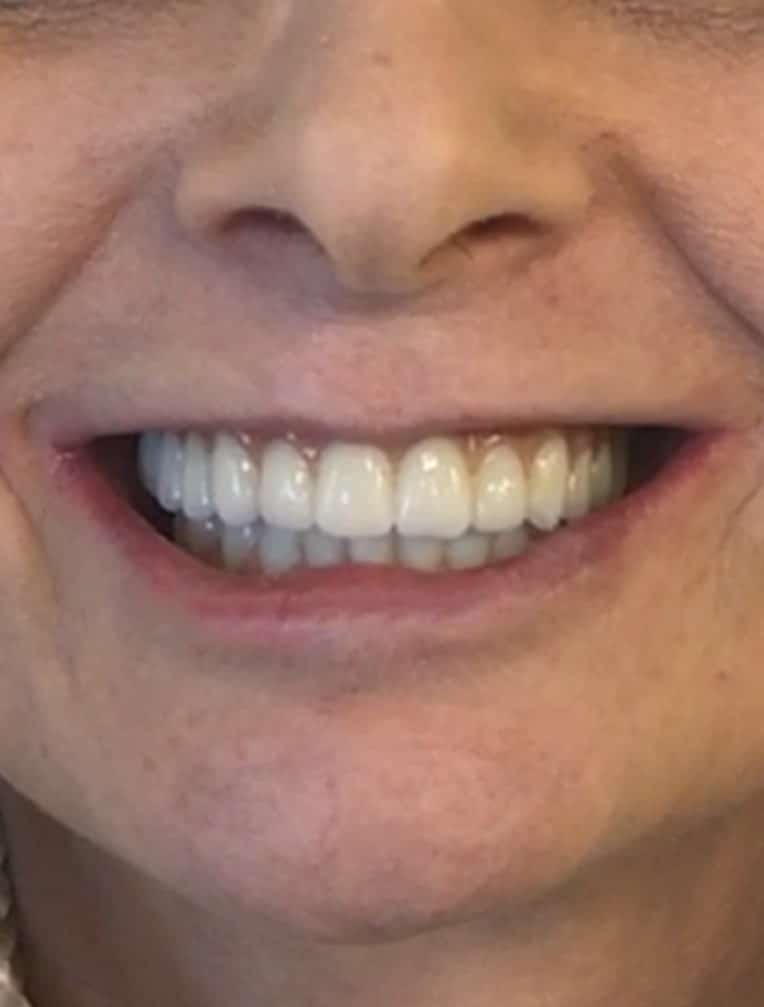
The aim throughout is a functional bite and fixed new teeth that let you eat, speak and get on with everyday life with confidence. You can see the difference this makes in our before and after pictures and patient reviews.
A clinician’s view
From a clinical standpoint, the cost isn’t only financial. Every surgical intervention carries a biological cost: bone volume and soft tissue are finite, and they don’t always fully recover once used. If treatment goes wrong and needs to be redone, the second attempt is rarely a clean repeat of the first: there may be less bone, more scar tissue or a narrower range of options that were available originally.
That is why an appropriate treatment plan that is carried out after a thorough assessment and explained along with available options, risks, advantages and disadvantages matters as much as the price on the quote. Some outcomes cannot be undone or repeated indefinitely.
At EvoDental, across the seven clinics, we commonly see patients who return from treatment abroad with very little to go on: no clear record of implant system used, and no detailed treatment notes; without knowing exactly what was used it’s difficult to plan a safe follow up. In most cases, the only option left is surgical removal of the implants and having corrective surgery from scratch.
Before deciding where to have treatment, it’s worth speaking to the clinical team who would be doing the work- ask about the implant system they use, how healing is planned and what happens if you need further treatment. At EvoDental, all the clinicians are happy to go through the details of your treatment, so you can provide informed consent. The right questions asked early are the best way to have treatment with confidence.
Maria Vassiliou, Clinical Lead, GDC 83566
Is travelling abroad for dental implants right for you?
There’s no single right answer, and many patients who consider treatment abroad are simply trying to make a sensible decision about a significant investment. The most useful thing you can do is look beyond the headline price and consider the full picture: aftercare, continuity of care, how complications would be handled and the total cost over time rather than the upfront figure alone.
If you’d like to understand your options with no pressure, the best next step is a free clinical assessment, where we can look at your individual situation and explain clearly whether full mouth dental implants are right for you.
Frequently asked questions about dental implants abroad
Are dental implants in Turkey safe?
Many clinics in Turkey provide good treatment, but standards, regulation and aftercare can vary. The main things to weigh up are less about any single clinic and more about the quality of the assessment, continuity of care, how any problems would be handled and the protections available to you as a patient.
How much do full mouth dental implants cost in the UK?
Costs vary depending on your individual case, which is why an accurate price is only possible after a proper assessment. Many patients are surprised to find UK treatment more attainable than expected once finance is taken into account. You can find clear information on UK treatment costs and finance options to compare like for like.
Can I finance dental implant treatment in the UK?
Yes. At EvoDental, finance options including 0% finance are available, which can spread the cost of treatment over time and make UK care more manageable than the upfront figure suggests. This often narrows the gap with lower advertised prices abroad.
What happens if something goes wrong after treatment abroad?
Arranging follow-up care can be more difficult once you’re back in the UK. Sorting out a problem may involve returning to the original clinic abroad or seeking further treatment at home, which can add time and cost. An experienced UK team like EvoDental can often help patients in this position.
Why are dental implants cheaper in Turkey?
Lower operating and labour costs account for much of the difference in the advertised price. However, the advertised figure may not reflect the total cost once travel, accommodation, follow-up visits and any further treatment are taken into account.
Should I get a scan in the UK to take abroad?
Some overseas clinics suggest getting scans in the UK to take with you. It’s worth being aware that scans form part of a clinic’s own assessment and planning process, and are taken in the context of the treatment that clinic intends to provide. At EvoDental, we take a CT scan as part of your free assessment so we can plan your treatment properly. If you’d like a copy of your scan to keep, this is available for a charge.
Is it worth travelling abroad for full mouth dental implants?
This depends on your individual circumstances. Rather than comparing upfront cost alone, it’s worth weighing up long-term value, including the quality of the assessment, aftercare, continuity of care and the total cost over time.